
Quick Summary
To select the best harvesting snips for fruit, match the blade tip, length and steel to the crop you pick most often and the thickness of its stems. Curved narrow tips suit clusters, while bypass blades give cleaner cuts than anvil designs. Stainless steel suits low maintenance, and carbon steel gives the sharpest edge.
- Use bypass blades for fruit, since they leave a cleaner wound than anvil designs.
- Berries and small grapes suit a fine-tipped bypass snip of roughly 140-160mm.
- Tomatoes, cucumbers and capsicum need a 160-190mm snip with a heavier spring.
- Stay comfortably below a snip's stated cutting capacity to avoid flexing and ragged cuts.
- Stainless steel resists rust, while carbon steel takes a sharper edge but needs drying and oiling.
Table of Contents
- Why the Right Harvesting Snips Matter for Fruit
- Harvesting Snips, Fruit Scissors and Pruning Shears: What Separates Them
- Bypass Versus Anvil Blades for Fruit Harvesting
- Matching Snip Size, Blade Length and Steel to Your Fruit
- Comparing Toolpro's Harvesting Snips by Use
- How to Clean Pruning Tools After Harvesting
- Choosing Your Harvesting Snips for the Season Ahead
- Frequently Asked Questions
Why the Right Harvesting Snips Matter for Fruit
Harvesting snips are a small tool with a big effect on fruit quality.
Toolpro supplies snips to growers, florists and home gardeners, and the same questions come up: which blade shape suits small stone fruit, how much steel type matters, and whether a pricier pair is worth it.
Harvesting snips have one job: to separate fruit from the plant cleanly.
A crushed stem or ragged edge usually signals a dull or wrong blade type. Treat that as a cue to review your snips rather than working harder with them.
Harvesting Snips, Fruit Scissors and Pruning Shears: What Separates Them
These three tools overlap, and the names are often used loosely. Harvesting snips are usually small, light and built for quick cuts through soft stems. Fruit scissors tend to have longer, finer blades for precise work close to the fruit. Pruning shears are sturdier and designed for woody branches, so they are generally too heavy for picking fruit by hand.
A light, short-bladed snip suits soft fruit and vegetables, while a longer, curved blade helps when reaching into a dense canopy. Pruning shears have a place in the orchard, but they are a different job.
Watch out: Using pruning shears on soft fruit stems can crush the stem instead of cutting it cleanly, which invites rot at the wound.
Bypass Versus Anvil Blades for Fruit Harvesting
Bypass blades pass each other like scissors, giving a clean, slicing cut. Anvil blades close onto a flat edge, which can crush the stem. For fruit harvesting, bypass blades usually give the cleaner result because they leave a smooth wound that heals faster.
Anvil designs handle tougher, drier stems but are less forgiving on delicate fruit wood. For soft fruit, a bypass design is usually the better starting point.
Matching Snip Size, Blade Length and Steel to Your Fruit
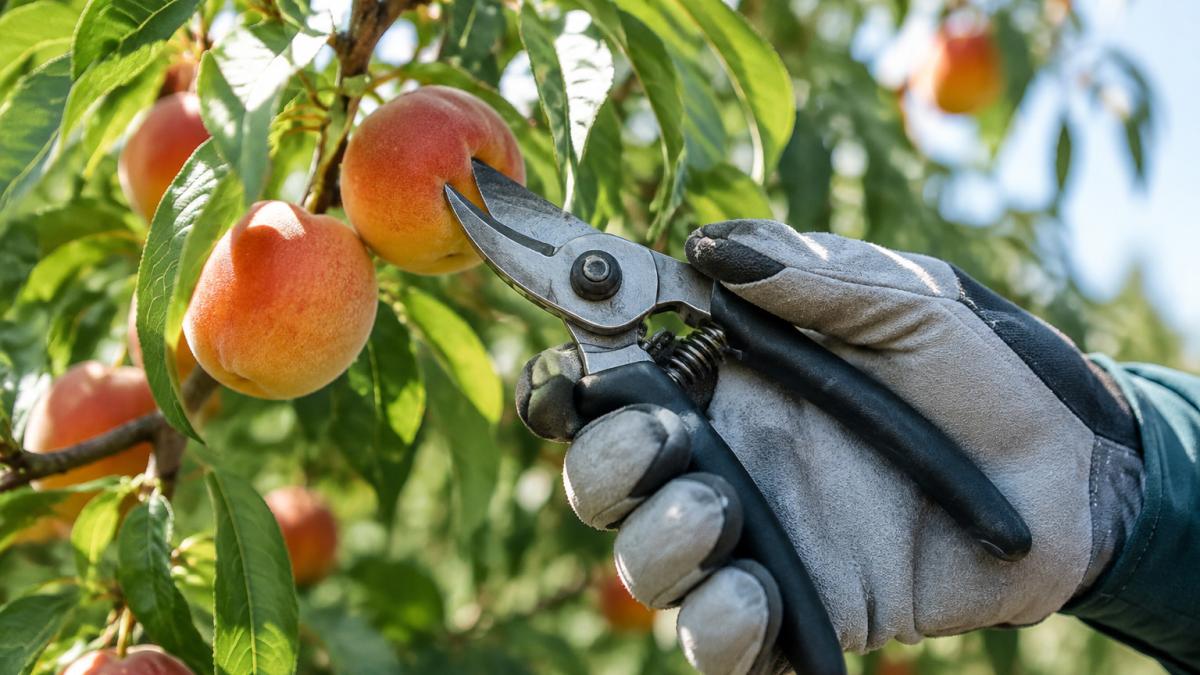
For fruit, the blade tip, jaw shape and spring action matter as much as length, because they determine whether you can reach behind a fruit and cut the stalk without touching the skin.
Start with the crop, not the catalogue
Work through the fruit you pick most often and note three things: the stalk diameter, how tightly the fruit clusters, and whether you cut one fruit at a time or a whole truss.
- Berries, currants and small grapes: thin, soft stalks and tight clusters. A short, fine-tipped bypass snip of roughly 140-160mm gives the control to cut a single pedicel without knocking neighbouring fruit; long blades swing into the cluster.
- Cherries and small stone fruit: short stalks and bruise-prone fruit. A narrow, slightly curved blade lets you hook behind the stalk and cut away from the fruit, with a tip fine enough to slide between fruit.
- Tomatoes, cucumbers and capsicum: thicker, sappy stalks. A 160-190mm snip with a heavier spring and a blade that closes fully under load avoids crushing. Snub-nose curved blades are common here.
- Citrus and larger tree fruit: short, woody stalks needing leverage. A 190-205mm snip, or a light pruner, gives the mechanical advantage; a delicate fruit scissor will strain and leave a ragged cut.
Growers picking mixed crops often keep two pairs: a fine 145-165mm snip for berries and small fruit, and a 190-205mm pair for tomatoes, citrus and stem work. For a guide focused on matching snips to small or thin stems, see the best professional snips for thin stems. For a low-cost option in the first group, see the economy curved stainless steel grape and fruit snips.
Blade tip and jaw design for harvesting
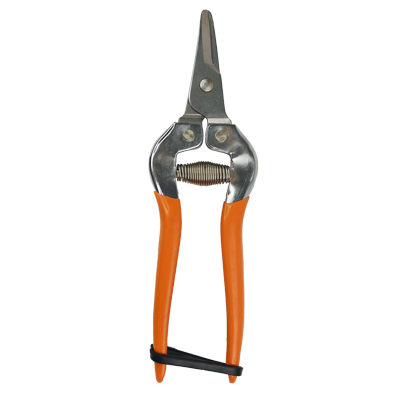
The tip is where most fruit damage happens. Three shapes dominate:
- Curved, narrow tips hook behind a stalk and cut with a pulling motion, keeping the blade away from the fruit. The most versatile shape for grapes, tomatoes and cherries.
- Snub-nose tips are short and strong, resisting bending on thicker stalks, but sacrifice reach in tight clusters.
- Straight, fine tips suit precision work such as trimming berry stalks, but bend easily on woody material.
A bypass jaw with a slight offset slices cleanly; a jaw that meets flush can pinch soft stalks. Check that the jaw closes completely along its whole length, a gap at the tip leaves uncut fibres and a ragged end.
!Close-up of a gloved hand holding harvesting snips beside a branch of ripe fruit
Stem thickness and cutting capacity
Every snip has a practical cutting capacity, usually stated as a maximum stalk diameter. Stay comfortably below it: a tool used at its limit flexes, cuts raggedly and dulls faster. If stalks are consistently thicker than about 8-10mm, move up to a light pruner.
Larger fruit also needs a comfortable grip and a blade that closes without strain, since you often hold the fruit steady with the other hand while cutting.
Stainless steel versus carbon steel
Stainless steel resists rust and is easier to keep clean, which suits frequent wet-weather picking and crops where hygiene matters. Carbon steel usually takes a sharper edge and is easier to resharpen, so you can compare the carbon steel harvesting snips directly.
Stainless steel suits the job when low maintenance and food safety matter most; carbon steel is a good choice when sharpness is the priority and you can keep the tool dry.
A practical buying checklist
Before you commit to a pair, confirm:
- The blade tip shape suits your main crop (curved narrow for clusters, snub-nose for thicker stalks).
- The stated cutting capacity is above your typical stalk diameter.
- The spring is replaceable or the handle opens for cleaning.
- There is a one-handed locking mechanism so you can pocket the tool safely between picks.
- Replacement parts and sharpeners are available for the range, so a snip can be maintained rather than replaced.
Watch out: A cheap snip with a non-replaceable spring often fails mid-season, and the cost of replacing the whole tool outweighs the saving.
Comparing Toolpro's Harvesting Snips by Use
Here is how the current Toolpro range sorts by use. Prices are starting prices in AUD.
| Product | Length | Steel | Starting Price | Best For |
|---|---|---|---|---|
| Snips Small Grape or Fruit Picking | 145mm | Not stated | $11.00 | Small grapes and fruit |
| Snips Grape/Fruit Harvesting Economy Curved Stainless Steel | 160mm | Stainless steel | $11.00 | Grapes and fruit, low maintenance |
| Fujiya Stainless Steel Snub Nose Curved Snips | 165mm | Japanese stainless steel | $11.00 | Grape, cucumber, tomato, mandarin |
| Chikamasa Harvesting Scissors | 145mm | Not stated | $30.00 | Fruit and small vegetables, light weight |
| Chikamasa Harvesting Scissors - Large | 205mm | Not stated | $35.00 | Fruit, vegetables, onion and garlic roots |
| Snips Harvesting Economy Carbon Steel | 165mm | Carbon steel | $12.50 | Economy harvesting, sharp edge |
| Fujiya Floristry or Harvesting Scissors - F508BT | 190mm | Japanese steel | $27.50 | Floristry and harvesting, spring-assisted |
| Chikamasa Stainless Steel Snips | 195mm | Stainless steel | $23.00 | Harvesting, light pruning, propagation |
| Chikamasa Carbon Steel Snips | 180mm | Carbon steel | $22.00 | Light pruning, floristry, harvesting |
| ARS 300L Snips | 190mm | Carbon steel | $21.00 | Nurseries, flower and fruit harvesting |
Starting Price
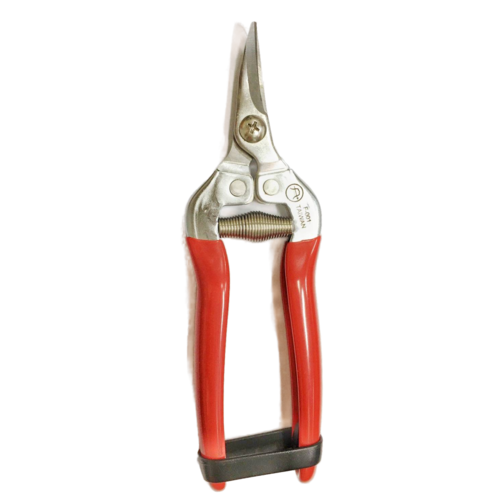
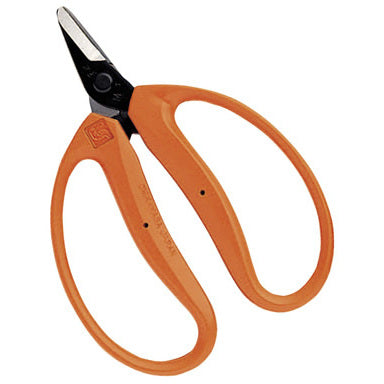
Chikamasa Harvesting Scissors ($30.00, 145mm) are light scissors for fruit and small vegetables. Best for: daily picking where weight matters. Skip if: you need a larger tool for big fruit.
Chikamasa Stainless Steel Snips ($23.00, 195mm) suit floristry, harvesting, light pruning and propagation. Best for: multi-purpose stainless work. Skip if: you want the lightest possible tool. For a deeper comparison of the best heavy duty snips in the range, see that guide.
Chikamasa Carbon Steel Snips ($22.00, 180mm) offer a carbon blade for light pruning, floristry and harvesting. Best for: a sharp edge and easy resharpening. Skip if: rust is a concern.
!Pair of harvesting snips on a wooden bench beside freshly picked fruit
How to Clean Pruning Tools After Harvesting
Cleaning is not just about keeping the blade sharp. Sap and plant debris left on a blade can harbour mould and bacteria, so a short routine after each session, plus a sanitising step when you move between plants, protects both the tool and the crop. For detailed instructions on removing sap from your snips, follow the full guide.
After every session
- Brush off debris. Use a stiff brush or a cloth to remove leaf fragments, stalk pieces and soil from the blades, pivot and spring.
- Wash the blades. Warm water with a little dish soap removes sap. Avoid leaving the pivot or spring soaking, because trapped water causes rust even in stainless tools.
- Dry thoroughly. Wipe with a dry cloth and leave the tool open to air before closing it.
- Oil carbon steel. A light coat of a food-safe oil on the blade prevents rust. Stainless steel benefits from a thinner coat on the pivot.
Sanitising between plants
When disease is a concern, after spotting leaf spot, canker or fruit rot, sanitise the blades between plants, not just at day's end. Wipe with a cloth dampened with a registered garden sanitising product, following the label for dilution and contact time, and let the blade dry before the next cut.
Watch out: Do not dip carbon steel blades in strong sanitising solutions and leave them wet; the edge can corrode quickly. Wipe, then dry.
Sharpening and edge care
A dull blade crushes rather than cuts, the most common cause of bruised fruit and ragged stems. Sharpen lightly and often: a fine diamond file or sharpening stone run along the existing bevel at the original angle restores the edge in a few strokes.
After sharpening, check that the blades close cleanly along their whole length. If they do not, adjust the pivot screw slightly rather than filing further.
Storage between harvests
Store snips closed and locked, in a dry place. A plastic pouch or holster protects the tip and keeps the blade away from moisture. Before the next season, check the spring, the pivot screw and the locking mechanism, and replace any worn parts so the tool is ready for the first pick.
Choosing Your Harvesting Snips for the Season Ahead
Start with the fruit you pick most often and your stem thickness. Choose stainless steel for low maintenance, carbon steel for the sharpest edge if you can keep it dry, and a blade length that reaches your fruit without awkward cuts.
Set a budget, but weigh it against how often you pick. A pair used daily through a harvest season earns back a higher price through cleaner cuts and fewer replacements.
Frequently Asked Questions
What are harvesting snips used for?
Harvesting snips are small, lightweight cutting tools used to pick fruit, vegetables and herbs by cutting the stem cleanly without pulling or twisting the produce. They suit grapes, tomatoes, cucumbers, mandarins and small fruit. Toolpro's range includes economy carbon steel snips from $11.00 and Japanese-made Chikamasa snips from $22.00, with lengths from 145mm to 195mm to suit different crops.
How do I choose snips for harvesting fruit?
Start with the stem thickness and the fruit size. Fine, thin stems on grapes or small fruit suit a shorter, narrow-tipped pair around 145mm to 165mm, while larger fruit and thicker stems may need a longer blade. Check that the blade tip can reach into the foliage and that the handles stay comfortable over long sessions. Stainless steel resists rust and suits frequent washing, while carbon steel can hold a sharper edge for long sessions.
Are bypass or anvil blades better for fruit harvesting?
Bypass blades pass each other like scissors and give a clean, slicing cut that suits living stems and fruit, which is why most harvesting work favours them. Anvil blades close onto a flat edge and can crush stems, so they are better suited to dead wood than to fruit.
How do I clean and maintain harvesting snips?
Wipe the blades after each session to remove sap and plant residue, then wash them in warm, soapy water and dry them fully before storing. Sap that builds up on the blades slows cutting and can spread disease between plants, so clean between different crops. Light oil on the pivot and a regular touch-up with a sharpener keep the blades cutting cleanly. Toolpro supplies sharpeners and spare parts to keep your snips in service longer.
