
Last Updated: November 17, 2026
Quick Summary
A professional pruning saw is worth it for orchards because it makes clean, controlled cuts through live wood repeatedly, and a dull or flexing blade slows every cut and leaves ragged edges. The right pick depends on branch size, with a folding ARS model suiting most growers.
- Match blade length to your typical branch diameter before buying.
- Blades around 330 to 380 millimetres with medium teeth cover most routine orchard pruning.
- Folding saws fit a holster and stay sheathed between cuts, protecting blade and user.
- The ARS Folding G18L costs $55.00 AUD and gives the longest blade for thicker limbs.
- Wipe sap off after each tree and dry the blade before sheathing to prevent corrosion.
Table of Contents
- Why a Professional Pruning Saw Matters in an Orchard
- Blade Length and Cutting Capacity Explained
- Folding Pruning Saws for Orchard Work
- Telescopic Pruning Saws and When Reach Matters
- Best Pruning Saw for Fruit Trees: Our Top Picks Compared
- Keeping Your Pruning Saw Sharp and Clean
- Choosing the Right Saw for Your Next Orchard Pruning Session
- Frequently Asked Questions
Why a Professional Pruning Saw Matters in an Orchard
A professional pruning saw is a hand saw built to make clean, controlled cuts through live wood repeatedly over a working day. In an orchard, that repetition matters more than it does in a home garden. Each tree may need dozens of cuts, and a dull or flexing blade slows every one of them and leaves ragged edges that take longer to heal.
The question growers ask most is whether a saw will keep cutting cleanly after a few hundred cuts. Japanese pull-stroke saws with carbon steel blades are designed for that kind of repeated use, and the pull stroke gives more control at height.
Orchard pruning also changes what you ask of a tool. Branches are often thinner and more numerous than on a shade tree, so you want a saw that handles quick, repeated cuts without tiring your wrist. Watch out: a saw that is too long for tight canopy work will catch on neighbouring limbs and cost you more time than it saves.
Blade Length and Cutting Capacity Explained
Blade length determines how much branch a saw can cut in one pass, but the more useful question for an orchard pruner is which blade length matches the wood you cut most often. Matching blade length and tooth pitch to your typical branch diameter helps narrow the choice before you buy.
As a working framework, treat blade length and tooth spacing as a pair. A short blade of around 200 to 250 millimetres with fine teeth suits clean cuts on small wood and tight canopy work. A mid-length blade of roughly 330 to 380 millimetres with a medium tooth pitch covers the bulk of routine orchard pruning. A long blade of 400 to 420 millimetres with coarser teeth removes material quickly on thicker limbs and gives a longer, smoother stroke.
Cutting capacity depends on both blade length and tooth geometry. Tooth spacing, or pitch, sets how aggressively the saw bites: coarser teeth clear green wood faster but leave a rougher surface, while finer teeth cut more smoothly but need more strokes. Gullet depth controls how much sawdust each tooth can carry out of the kerf, so a shallow gullet clogs sooner in sappy green wood.
A practical branch-diameter guide looks like this. For limbs under about 25 millimetres, a 200 to 250 millimetre blade with fine teeth gives control and a clean finish. For limbs of roughly 25 to 60 millimetres, a 330 to 380 millimetre blade with a medium pitch is the versatile choice. For limbs above about 60 millimetres, step up to a 400 to 420 millimetre blade with coarser teeth, and expect to make a few passes rather than one. These are working ranges, not hard limits, and the condition of the wood changes them.
Watch out: a blade that is too long for tight canopy work will catch on neighbouring limbs and cost you more time than it saves, so do not simply buy the longest saw in the range.
Our folding GR-17 measures 379 millimetres and the G18L measures 410 millimetres. The longer G18L gives more reach for larger limbs, while the GR-17 is easier to carry along a row. The Leyat Folding at 205 millimetres is shorter, so it suits smaller wood.
Folding Pruning Saws for Orchard Work
A folding saw is the most practical choice for most orchard pruners. The blade locks into the handle, so the saw fits a belt holster or a pocket and stays sheathed between cuts. That protects the blade and protects you.
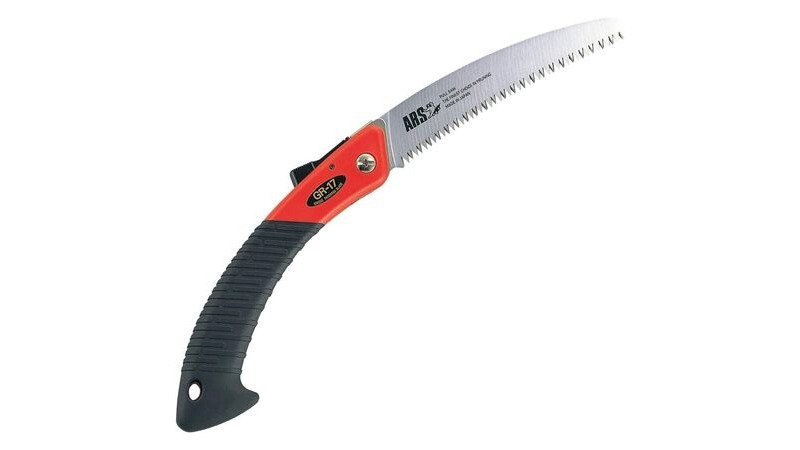
The ARS Pruning Saw - Folding GR17 is made in Japan from high quality carbon steel and is suited to orchards, nurseries, gardening and landscaping. It is priced at $60.00 AUD and is our pick for growers who prune across many tree sizes in a single session.
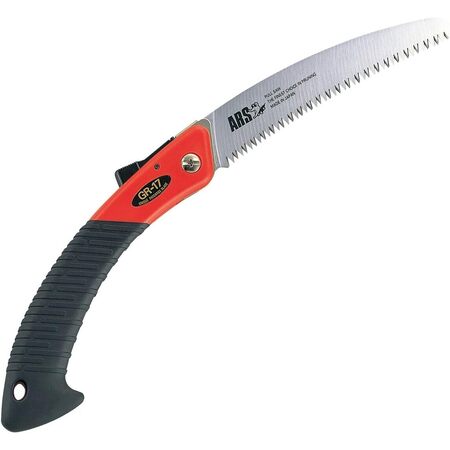
The ARS Pruning Saw - Folding G18L is also made in Japan from high quality carbon steel and suits the same work. At $55.00 AUD, it is the better value of the two if your limbs run thicker and you want the extra blade length.
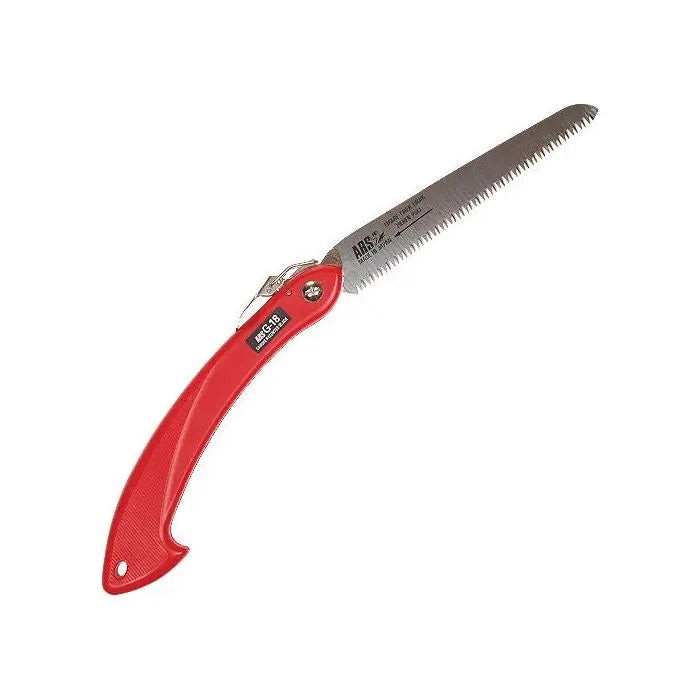
The Leyat Pruning Saw - Folding is made from high quality carbon steel with a plastic handle and is 205 millimetres long. At $45.00 AUD, it is the lightest-cost folding option in our range, though the shorter blade limits it to smaller wood.
Telescopic Pruning Saws and When Reach Matters
A telescopic saw extends the cutting head on a pole, letting you reach limbs high in the canopy without a ladder. For large mature trees, this saves time and reduces the risk of working from unstable ladders in the orchard.
The trade-off is control. A pole saw gives you less precision than a hand saw, and the stroke is harder to keep straight at full extension. Reach matters most when the high limbs are the ones that need removing and you cannot get safe access otherwise.
Toolpro's current range in this guide is limited to folding hand saws, so if reach is your main requirement, check telescopic options separately before you buy.
Best Pruning Saw for Fruit Trees: Our Top Picks Compared
For fruit trees, the ARS Pruning Saw - Folding G18L has a longer blade and is made from Japanese carbon steel, which suits larger limbs. For tighter work, the ARS GR-17 is a shorter option.
Comparison Table and Pricing
| Saw | Blade Length | Price (AUD) | Best For | Pros | Cons |
|---|---|---|---|---|---|
| ARS Folding GR-17 | 379 mm | $60.00 | General orchard and nursery work | Japanese carbon steel, folds for storage | Shorter reach on thick limbs |
| ARS Folding G18L | 410 mm | $55.00 | Larger limbs and mature trees | Longest blade in range, good value | Heavier to carry all day |
| Leyat Folding | 205 mm | $45.00 | Small wood and light use | Lowest price, lightweight | Limited to smaller branches |
Blade Length
ARS Folding GR-17 (Best for general orchard work) Japanese carbon steel and a folding design make this the most versatile saw here. For a deeper guide to saws built for fruit trees, see durable pruning saws for fruit trees. It handles most orchard limbs without strain. The main limitation is its shorter reach on thicker wood.
ARS Folding G18L (Best for mature trees) The longest blade in our range cuts through larger limbs in fewer passes. It costs less than the GR-17 and is the better value for thick wood. It is heavier, which shows over a long day.
Leyat Folding (Best for light, occasional use) At $45.00 AUD, this is the budget option. The plastic handle and 205 millimetre blade suit small wood and light pruning, but it will not keep up with a commercial workload.
Keeping Your Pruning Saw Sharp and Clean
A sharp, clean blade is the single biggest factor in cut quality, and in an orchard the maintenance routine matters as much as the initial purchase. Sap can dry on the teeth and in the gullets, which makes cutting harder over time. Wipe the blade with a cloth after each tree, and carry a small rag dampened with a little methylated spirits for stubborn sap. Dry the blade before sheathing it, because moisture trapped against carbon steel is what starts corrosion.
Sharpening is where most growers either save or waste money. Sharpen when you notice the saw pulling or tearing rather than slicing, or when the teeth reflect light along the edge. Use a fine triangular file matched to the tooth size, and work each tooth at the original angle and in the same direction. Japanese pull-cut saws are typically hardened to a high Rockwell hardness, which means the teeth hold an edge for a long time but are brittle: file them lightly and do not force a dull saw through thick wood, or you will snap teeth rather than sharpen them. A common pattern is that a hard-used orchard saw needs a light touch-up every few weeks in season rather than one heavy sharpening a year.
Once teeth are missing or the blade is bent, the blade may need replacing. Before buying, consider how long a saw's blade lasts and what a replacement costs, and check whether spare parts are available for the model you choose.
Storage matters too. Store the saw sheathed, dry and out of direct sun, and avoid leaving it in a hot vehicle where the handle material can soften and the blade can sweat. A light film of camellia oil or a similar non-drying oil on the blade between uses slows corrosion without attracting grit.
Choosing the Right Saw for Your Next Orchard Pruning Session
Start by listing the branch sizes you cut most often. If most limbs are under 40 millimetres, a 379 millimetre blade will serve you well. If you regularly cut thicker wood, the 410 millimetre G18L is the safer choice.
Next, consider how you will carry the saw. For long sessions across a large orchard, a folding saw that fits a holster is more practical than a fixed-blade model. Check the weight in your hand before you commit, because a saw that feels fine for ten minutes can tire you by midday.
Finally, match the saw to the work. Use the Leyat for light, occasional pruning, the GR-17 for general orchard work and the G18L for mature trees. If you need reach beyond what a hand saw provides, plan for a telescopic option as a separate purchase.
Browse the range and choose the blade length that matches your trees.
Frequently Asked Questions
What type of pruning saw is best for orchard trees?
For most orchard work, a curved-blade hand saw with a sharp, hardened cutting edge gives the cleanest cuts on live wood. The ARS Pruning Saw - Folding GR17 at $60.00 is made in Japan from high quality carbon steel and suits orchards, nurseries and landscaping. Choose a blade length that matches the branch sizes you cut most often.
What size pruning saw blade is best for fruit trees?
Blade length affects how much of a branch you can cut in one stroke. The ARS Pruning Saw - Folding G18L, at 410mm long and priced at $55.00, is longer, while the Leyat Pruning Saw - Folding at 205mm suits smaller, tighter branches. For most fruit tree maintenance, a blade around 300 to 400mm handles the majority of cuts without overreaching.
Are folding pruning saws suitable for professional orchard work?
Folding pruning saws can be carried on a belt or in a pocket, which many orchard pruners find practical. The ARS Pruning Saw - Folding GR17 is designed for orchards and nurseries and is priced at $60.00. The Leyat Pruning Saw - Folding at $45.00 is a lighter option for shorter days or smaller operations. Check that the locking mechanism stays firm before each session.
How do you keep a pruning saw sharp and clean?
Wipe the blade after each tree to remove sap, which can build up and slow cutting. Dry the blade fully before storing it to prevent rust. Sharpen the teeth with a fine file when cuts start to tear rather than slice. Store the saw folded and dry, and
