
Last Updated: November 8, 2026
Quick Summary
Durable pruning saws for fruit trees are built with high quality carbon steel, sharp evenly spaced teeth and a rigid blade joined securely to the handle. Choose the blade length by branch diameter, use mid-length saws for most orchard work, and clean and dry the blade after every session to prevent rust.
- Carbon steel holds a sharp edge and is easy to resharpen, but it needs drying to avoid rust.
- Use a compact saw up to about 25mm, a 350-380mm blade for 25-60mm, and a 410mm blade for 60-100mm.
- Above about 100mm, use a chainsaw or call an arborist rather than a pruning saw.
- Wipe sap off the blade after every session, then dry it fully and oil the blade before storage.
- Replace the saw when teeth are missing or uneven, the blade is bent, or the folding lock has play.
Table of Contents
- What Makes a Pruning Saw Durable: Steel, Teeth and Build
- Choosing the Best Pruning Saw for Fruit Trees by Branch Size
- Japanese Pruning Saws: Why Many Orchardists Prefer Them
- Pruning Saw Blade Length and Cutting Reach
- Keeping a Pruning Saw Sharp and Clean Between Trees
- Booking Your Next Saw: Choosing the Right Toolpro Model
- Frequently Asked Questions
Durable pruning saws for fruit trees are the tools that keep working season after season, and at Toolpro we have built our range around that single requirement. A backyard tree gets trimmed a few times a year. An orchard tree can take hundreds of cuts in a single week. That difference in workload decides which saw survives and which one ends up in the shed with a snapped blade.
In an orchard, a saw is used hard, often in wet grass, and cleaned rarely. A folding saw that suits a backyard may not hold up when it cuts through thick limbs day after day. We made the ARS Folding Pruning Saw GR17 for exactly this kind of work. It is made in Japan from high quality carbon steel and sized for orchards, nurseries and landscaping, at 379mm long and $60.00.
Durability starts with the blade, but it also depends on how the saw is handled between jobs. Sap, dulled teeth and rust in the folded position are common causes of wear.
What Makes a Pruning Saw Durable: Steel, Teeth and Build
A durable pruning saw is defined by three things: the steel the blade is made from, the shape and hardness of its teeth, and how the blade is joined to the handle. Steel quality decides how well the edge holds. Tooth design decides how fast and cleanly the saw cuts. Build quality decides whether the blade stays put under load.
Carbon steel is the common choice for Japanese-style folding saws, and it is the material used across our ARS range. Carbon steel takes a sharp edge well and is easy to resharpen, but it needs drying after use to avoid rust. Look for a blade that is rigid rather than flexing when you press it against a branch.
Check the teeth before you buy. Sharp, evenly spaced teeth cut on the pull stroke and clear sawdust quickly. Worn or unevenly set teeth make you push harder, which stresses the blade and the handle.
Choosing the Best Pruning Saw for Fruit Trees by Branch Size
Most pruning-saw advice stops at "use a longer blade for bigger branches". That is not enough when you are standing in front of a fruit tree. The saw that suits a 20mm apple shoot is not the saw you want for a 90mm peach limb, and the wood itself changes how the teeth behave. Match the saw to the branch you cut most often and you will cut faster, tire less and put less stress on the blade.
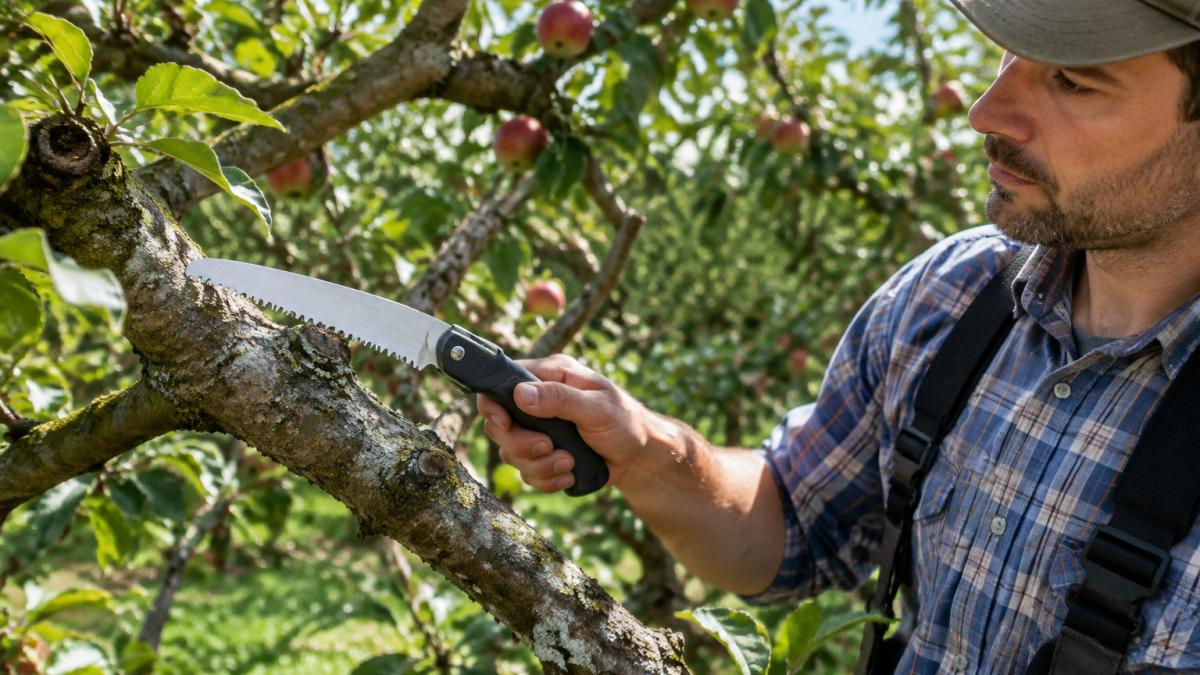
Start with branch diameter. As a working guide for fruit trees:
- Up to about 25mm: a compact folding saw, such as the Leyat Pruning Saw - Folding at 205mm and $45.00, is a shorter option for smaller work.
- 25mm to about 60mm: a mid-length blade in the 350-380mm range covers most backyard and small-orchard work. The ARS Folding Pruning Saw GR17 at 379mm and $60.00 is a mid-length option for this band.
- 60mm to about 100mm: reach and rigidity matter more than finesse. The ARS Pruning Saw - Folding G18L at 410mm and $55.00 is a longer option for this range.
- Above about 100mm: a handsaw becomes slow and inaccurate. Use a chainsaw or call an arborist rather than forcing a pruning saw through a limb it was not designed for.
Wood hardness matters as much as diameter.


Watch out: buying one saw for every job usually means a blade that is too long for fine work and too short for heavy limbs. If you prune a mix of young and mature trees, two saws, a compact fine-tooth model and a longer orchard blade, often cost less over time than replacing a single overloaded saw.
A simple test before you buy: hold the saw against a branch of the size you cut most. The blade should span the limb comfortably, the teeth should sit square to the wood, and the handle should let your wrist stay neutral. If you have to angle the saw or force it, the size is wrong for that job.
The article's branch-size guide can be scanned at a glance, so here is a summary of the saws it recommends for each diameter band.
| Saw mentioned | Length and price |
|---|---|
| Leyat Pruning Saw - Folding | 205mm, $45.00 |
| ARS Folding Pruning Saw GR17 | 379mm, $60.00 |
| ARS Pruning Saw - Folding G18L | 410mm, $55.00 |
| Chainsaw or arborist | Not a pruning saw job |
Price of pruning saws mentioned in the article
Japanese Pruning Saws: Why Many Orchardists Prefer Them
Japanese pruning saws cut on the pull stroke, which lets the blade stay thin and flexible while still cutting quickly.
The ARS saws are made in Japan from high quality carbon steel.
The ARS IK-10 Bonsai Saw - Folding, at $25.00, is made with carbon steel blades and is suitable for bonsai and all fine pruning.
Pruning Saw Blade Length and Cutting Reach
Blade length sets how much of the limb you can cut in one stroke and how far you can reach into the canopy. A longer blade cuts large limbs in fewer strokes, but it is harder to control in tight spaces. A shorter blade gives precise control but takes more effort on thick wood.
As a rough guide, use a longer blade for limbs you would otherwise cut with loppers, and a shorter blade for twigs and fine detail. The ARS GR17 at 379mm covers most general orchard work. The G18L at 410mm gives extra reach for higher limbs, at the cost of a little more weight to manage.
Keeping a Pruning Saw Sharp and Clean Between Trees
Sap, moisture and grit can shorten a pruning saw's life, so a regular cleaning routine helps.
After every session. Wipe the blade with a damp cloth to lift sap before it hardens, then dry it fully. Sap left overnight sets into a sticky film that dulls the teeth on the next cut and traps moisture against the steel. A light wipe of oil on the blade, not the handle, protects the steel in storage, especially in humid or coastal conditions.
Rust prevention. Carbon steel takes a sharp edge but rusts readily if folded away wet. Never store a folding saw closed with moisture on the blade. If surface rust appears, remove it with a fine abrasive pad and oil the steel; do not use a coarse file on the flat of the blade, which removes metal and weakens the plate.
Sharpening limits. Resharpening restores a working edge, but it is not unlimited. Each pass with a fine file removes a little tooth material, and Japanese-style teeth are hardened and precisely set. Resharpen when cuts begin to tear or when you find yourself pushing harder than usual, not on a fixed calendar.
When to replace rather than sharpen. Replace the blade or saw when teeth are missing or unevenly worn, when the blade has lost its set and wanders in the cut, when the folding lock develops play, or when the blade plate is bent. A loose hinge is often the first sign of wear and is cheaper to fix early than to ignore.
Replaceable blades.
End-of-season check. Inspect the lock, hinge and handle fixings at the end of each season. Clean and oil the pivot, tighten any loose screws, and store the saw dry and open enough to let air reach the blade. A few minutes at the end of the season prevents the two failures that end most saws' lives: a seized hinge and a rusted blade.
Watch out: rinsing a saw under a tap and folding it away wet is the most common way orchard saws fail. Water sits in the hinge and along the blade, and rust starts before the tool is next used. Dry it properly, every time.
Booking Your Next Saw: Choosing the Right Toolpro Model
Start by listing the branch sizes you cut most often and how often you work in an orchard. Then pick the model that matches. The ARS GR17 is priced at $60.00 and the ARS G18L at $55.00. The Leyat is priced at $45.00.
Ready to choose? Search the Toolpro range to find the saw that fits your branch size and budget.
Frequently Asked Questions
What type of pruning saw is best for fruit trees?
For most fruit trees, a folding pruning saw of around 200 to 400 millimetres handles the typical range of branch sizes well. Toolpro's ARS Folding Pruning Saw GR17 at $60.00 and ARS G18L at $55.00 are both made in Japan from carbon steel and suited to orchards and nurseries. Match the blade length to the branches you cut most often.
Are Japanese pruning saws good for fruit trees?
Yes. ARS saws from Toolpro are made in Japan from high-quality carbon steel and are suitable for orchard use.
How often should you clean a pruning saw between trees?
Dry the blade fully before storing it, because carbon steel rusts when left damp.
How do you keep a pruning saw sharp?
Replace or sharpen the blade when cuts start to tear rather than slice. Use a fine file that matches the tooth pitch, file each tooth at the same angle, and keep the work light. Toolpro supplies spare parts and sharpeners for its range.
